
Your GST registration documents should establish who the applicant is, who can sign for it and why it can use the declared premises. Circular 257 organises the first questions in Annexure II and the premises question in Annexure III. Build the pack for your actual entity and occupation route rather than collecting an indiscriminate bundle. CBIC Circular 257, Annexures II–III
This checklist is for preparing evidence. The GST registration guide covers eligibility and filing, while the table below helps you identify which document is missing before the application begins.
GST registration documents by business constitution#
Start with the PAN belonging to the applicant. A company or LLP applies under its own PAN; a sole proprietorship uses the proprietor’s identity. Keep the trade name separate from the PAN-based legal name. Circular 257, paras 3.1–3.4 and Annexure II
| Constitution | Business evidence | People and authority |
|---|---|---|
| Sole proprietorship | Proprietor PAN; premises proof selected separately. | Proprietor photograph and relevant Aadhaar/authentication details; authorisation if someone else is signatory. |
| Partnership | Firm PAN and partnership deed. | Relevant partners’ photographs, managing/authorised-partner particulars and signatory authorisation. |
| LLP | LLP PAN and incorporation/constitution evidence appropriate to its category. | Designated/authorised-partner details and photographs; authorisation in the prescribed manner. |
| Private/public company or OPC | Company PAN and certificate of incorporation. | Relevant director particulars, photographs and authorised-signatory identity and appointment evidence. |
| HUF | HUF PAN. | Karta identity and photograph; relevant authorisation where applicable. |
| Trust, society, club or association | Entity PAN and registration certificate or other constitution proof. | Trustee or managing-committee details and photographs, plus authority for the signatory. |
| Government department | Department PAN and constitution/department evidence. | DDO/person-in-charge details, appointment evidence and signatory authority. |
| PSU or local/statutory authority | Entity PAN and incorporation or constitution evidence. | Relevant executive/authorised-person particulars, photographs and authorisation. |
This table summarises Annexure II; it does not replace its entity-specific details or the live form. Overseas entities, foreign signatories and unusual constitutions require their own review.
Photos, Aadhaar and authorisation are different items#
The photograph identifies the relevant promoter, partner or signatory. The authorisation demonstrates why that person can act for the applicant. Aadhaar authentication or a facilitation-centre visit is a separate verification process; a photograph upload does not complete it. Circular 257, paras 3.5–3.6 and 5.2
For an entity, check that the authorisation names the same person selected as primary authorised signatory. If you replace that person during preparation, review both the form and the signed authority. Do not leave the old name in an attachment merely because the portal fields have changed.
Bank details also appear in Annexure II, but the operative timing is clarified in paragraph 3.11. Their appearance in a checklist does not make a new bank account a universal precondition to starting REG-01. Circular 257, para 3.11
Premises evidence under Annexure III#
The document route depends on the applicant’s right of occupation. Someone else’s ownership is not the same as the applicant owning the property, even when that person is a founder’s parent or the company’s director. Circular 257, para 3.8.2.1 and FAQ Q.22
| Premises category | What to prepare | Review point |
|---|---|---|
| Owned by applicant | One qualifying document in applicant’s name: latest property-tax receipt, municipal khata, property-identification document, latest electricity bill or latest water bill. | Match the complete premises address. |
| Inherited, with no applicant-name document | Death certificate and prescribed Annexure IV affidavit, with the supporting property evidence required for the facts. | Detailed paragraph and annexure wording need careful reconciliation. |
| Direct rent/lease, registration required | Valid registered agreement. | Check state law, instrument and term before relying on an unregistered copy. |
| Direct rent/lease, registration not required | Agreement and qualifying premises evidence in lessor’s name, subject to the tenant-bill alternative. | Include complete executed pages. |
| No written rent agreement | Annexure V undertaking and evidence of genuine occupation under para 3.8.3(b). | See the narrower tenant-name utility guidance below. |
| Owner consent | Signed Annexure VI letter on plain paper and one qualifying document in consenter’s name. | Consent-basis co-owned premises need the relevant owners’ consent. |
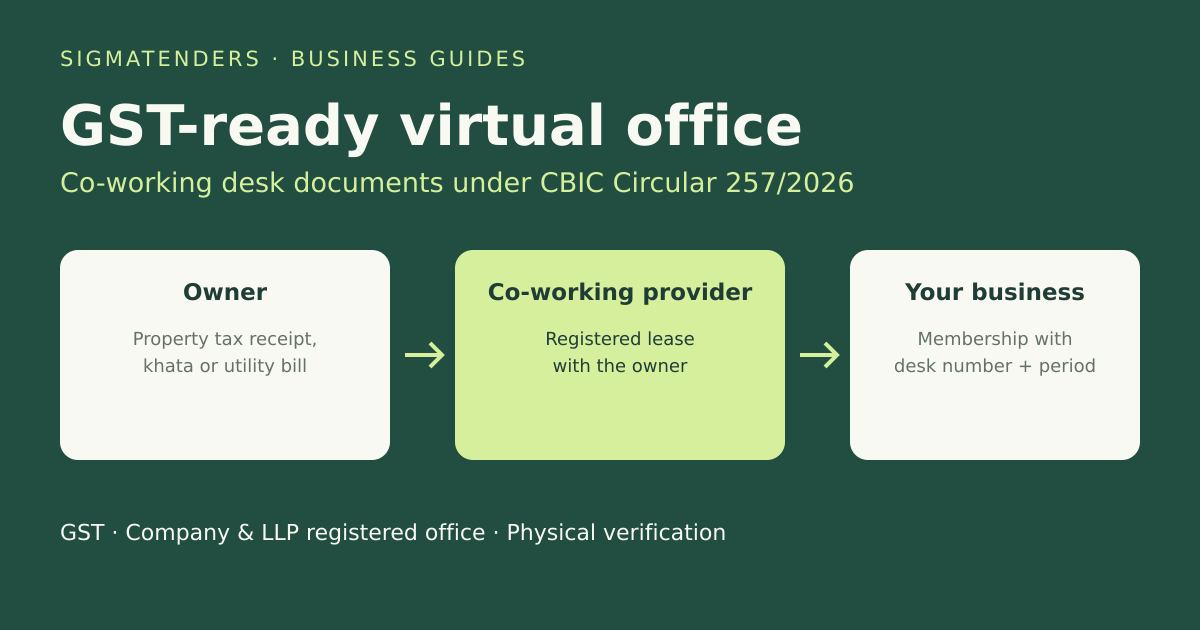
| Co-working, provider owns | Membership plus one qualifying property document in provider’s name. | Membership identifies period and allocated space. |
| Co-working, provider leases | Membership plus valid registered agreement between property owner and provider. | A provider bill alone does not replace that lease. |
| SEZ unit/developer | Valid approval/permission from the Development Commissioner. | Confirm the approved premises and validity. |
Sources: Circular 257, paras 3.8.2–3.8.6 and Annexure III. These are alternatives according to the facts, not a direction to upload the whole table.
For an additional place of business within the same state, the circular uses the same premises-document principles. Prepare evidence separately for each declared location rather than assuming the principal-place upload covers a warehouse elsewhere. Circular 257, para 3.9 and FAQ Q.33
Electricity bill for GST registration: whose name should appear?#
The answer changes with the route. Owned premises normally use a qualifying document in the applicant’s name. Consent uses the owner’s/consenter’s document. An unregistered direct tenancy generally combines the agreement with a lessor-name document. Circular 257, paras 3.8.2–3.8.4
Paragraph 3.8.3(a)(iii) allows a latest electricity or water bill in the tenant applicant’s name, showing the complete address, together with the valid rent agreement in place of the lessor’s premises proof. Do not strip out the agreement and present the tenant’s bill as though it alone proves a tenancy. Circular 257, para 3.8.3(a)(iii)
FAQ Q.34 addresses a landlord-name shared meter: the registered agreement is sufficient for that rental route; where the agreement is unregistered, upload the agreement with one qualifying landlord-name document. A shared meter does not automatically mean rejection. Circular 257, FAQ Q.34
For GST, the circular refers to the latest electricity/water bill in these categories. Do not import a universal “not older than two months” condition from company incorporation guidance. Read the requirement for the filing you are actually making. Circular 257, para 3.8.2.2
When there is no agreement#
Paragraph 3.8.3(b) and FAQ Q.25 describe the undertaking with evidence such as the applicant tenant’s latest electricity/water bill. Annexure III’s summary refers more broadly to applicant- or owner-name documents. Because that wording is not identical, have the CA resolve the applicable evidence rather than treating an owner bill alone as a guaranteed substitute. Circular 257, para 3.8.3(b), FAQ Q.25 and Annexure III
The rent agreement and undertaking page provides an Annexure V draft tool. It is for truthful statements about existing occupation; it does not legalise a tenancy that required registration or supply missing possession facts.
Consent letters, NOCs and co-owners#
For family-, partner- or director-owned premises made available on consent, Annexure VI is the circular’s consent-letter format. It includes a no-objection statement and identifies the owner, applicant, relationship, premises and any allocated portion. Use the GST consent/NOC generator to prepare a draft for the owner’s review. Circular 257, para 3.8.4 and Annexure VI
There are two different co-owner situations. Paragraph 3.8.4 requires consent from all owners for consent-basis premises owned jointly. FAQ Q.37 says that an applicant who itself jointly owns the property does not need NOCs from the other co-owners. Do not extend the latter answer to every non-owner applicant. Circular 257, para 3.8.4 and FAQ Q.37
Check that signatures were applied to the final version. A typed name, an unsigned downloaded draft or a letter describing a different floor can leave the permission unproved. Review the spelling against the supporting property evidence before asking owners to sign again.
Co-working membership: the allotted space matters#
“Virtual office” is not a phrase used in Circular 257. Paragraph 3.8.5 covers co-working premises with a membership agreement identifying the period, allotted suite/cabin/desk number and whether the provider owns or leases the property. Circular 257, para 3.8.5
For leased centres, the registered owner–provider lease is the supporting chain; for provider-owned centres, use a qualifying provider-name property document. A generic mailing-service invoice does not establish those requirements. Compare the documents before choosing a plan through the GST-ready virtual office guide. Circular 257, FAQ Q.26
Ask for the draft membership and identify who signs as provider. If an intermediary sells the plan, make sure the executed documents still identify the actual provider and the property rights it relies on. A marketing brand can differ from the legal name, but the documentary connection should be explainable.
Upload formats and file sizes#
The official manual specifies field-dependent limits. The following were checked on 17 November 2026; the live portal instruction beside the field governs if it changes. GST registration manual
| Upload | Manual’s stated format/limit |
|---|---|
| Promoter/partner photograph | PDF or JPEG, up to 100 KB. |
| Authorised-signatory photograph | PDF or JPEG, up to 100 KB. |
| Proof of appointment of authorised signatory | PDF or JPEG, up to 1 MB. |
| Principal-place proof | PDF or JPEG, up to 1 MB. |
| Relevant e-KYC documents | PDF or JPEG, up to 2 MB. |
Do not assume that a file below 2 MB will fit every field. Where several pages establish the occupation chain, combine them in the order required by the live form and check readability after compression. Do not change a possession category merely to avoid supplying the right evidence.
Reopen the uploaded file from the saved application where possible. Check page rotation, cut-off margins, missing signatures and whether numbers remain readable on a normal screen. Keep the signed original and the exact submitted version so that a later clarification can be answered consistently.
Bank details and post-registration timing#
The bank account must belong to the applicant/registered person and be obtained on its PAN. Supply the account number, bank/branch and IFSC with the relevant passbook page, statement or cancelled cheque evidence when furnished. Circular 257, para 3.11
Initial registration does not require bank details where they are not yet available. After grant, provide them within 30 days or before filing outward-supply details in GSTR-1/IFF, whichever is earlier. Put that event in the compliance calendar immediately after approval. Circular 257, para 3.11
Before the CA submits your document pack
- Legal name and PAN belong to the same applicant.
- Constitution document matches the selected business type.
- Signatory appointment and identity refer to the person in REG-01.
- Possession category follows the signed arrangement.
- Address, allotted space and PIN agree across the evidence.
- Scans contain full pages and fit each field’s displayed limit.
- Owners have signed consent where that route applies.
- Authentication appointments and bank-detail follow-up have an owner.
If a notice identifies a genuine mismatch, correct the underlying evidence and explain it point by point. For an actual rejection order, use the registration rejection guide. The circular also limits unwarranted presumptive queries; it does not excuse incomplete or illegible submissions. Circular 257, paras 5.4–5.5
SigmaTenders can help review the address document pack, coordinate CA-assisted applications, prepare for physical verification and handle mail through verified partner co-working spaces. Price on request. The service is available through partner spaces; we confirm availability in your city within 48 hours. Ask us which premises documents your application needs.
GST registration documents FAQs#
GST registration ke liye documents: where should I start?
Start with applicant PAN and constitution, relevant people and signatory authority, then choose the premises route. A proprietor, LLP and company do not use identical entity evidence. Circular 257, Annexures II–III
Are photographs of the landlord standing at the premises required?
No. FAQ Q.35 says applicant/landlord premises photographs are not required or accepted as premises proof. Officer site photographs and biometric-centre photographs serve separate purposes. Circular 257, FAQ Q.35 and paras 5.2, 5.6
Does every applicant need a landlord NOC?
No single landlord letter applies to all categories. Owned, rented, consent and co-working routes have different evidence. Use the category corresponding to the facts. Circular 257, Annexure III
Can I upload a 2 MB premises PDF?
The checked manual states 1 MB for principal-place proof. Its 2 MB allowance applies to relevant e-KYC uploads. Follow the limit displayed beside your actual field. GST manual
Is Udyam compulsory premises evidence for GST?
The circular prohibits unwarranted demands for an Udyam certificate and does not make it a substitute for the prescribed place-of-business documents. Circular 257, para 5.4.1 and FAQ Q.36