
GST for export of services involves two separate tests: whether you need registration, and whether your work qualifies as an export. Freelancers supplying services generally register after aggregate turnover exceeds ₹20 lakh, or ₹10 lakh in the four specified states. A qualifying export is zero-rated, but a foreign client’s address alone does not establish export status. CBIC threshold guidance · IGST Act, section 2(6), reproduced in official guidance
Start with your turnover and contracts before paying for freelance office space. Then choose premises whose documents and actual use you can explain.
GST for freelancers: is registration mandatory?#
“Freelancer” is a working description, not a separate GST registration category. For ordinary taxable consultancy, design or IT services, assess the service-supplier thresholds below, alongside any compulsory-registration provision. The higher threshold available to qualifying exclusive suppliers of goods should not be applied to freelance service income. CBIC, registration thresholds
| Where you supply services from | General annual registration threshold | Primary reference |
|---|---|---|
| Most states and Union territories | Aggregate turnover exceeding ₹20 lakh | CBIC threshold guidance |
| Manipur, Mizoram, Nagaland and Tripura | Aggregate turnover exceeding ₹10 lakh | CBIC threshold guidance |
The ₹10 lakh shorthand for “special category states” does not mean every historically special-category state still has that service threshold. Use the four-state list above. A government parliamentary answer also confirms these service limits for interstate and intrastate supplies.
Aggregate turnover is an all-India, same-PAN calculation. It includes taxable supplies, exempt supplies, exports and interstate supplies; it excludes GST and cess, and inward supplies taxed under reverse charge. Do not test only your domestic invoices or subtract expenses to arrive at profit. CBIC sectoral FAQs, aggregate-turnover definition under CGST section 2(6)
Export receipts count towards aggregate turnover even where supplies are zero-rated. Track them alongside Indian consultancy and other business supplies under the same PAN, using the statutory turnover definition. A running invoice register can help your CA identify when you approach the applicable threshold.
Interstate clients and foreign clients below the threshold#
Do not assume one client outside your state makes registration compulsory. Notification No. 10/2017–Integrated Tax exempts interstate suppliers of taxable services within the applicable turnover limit. Read it with Notification No. 03/2019–Integrated Tax, which amended its special-category reference. Accordingly, an otherwise eligible small service exporter can use this exemption; exports are treated as interstate supplies under IGST section 7(5). 2017 notification · 2019 amendment · IGST Act, section 7
Other compulsory-registration grounds still need review, including liability to pay tax under reverse charge. Voluntary registration is also possible. Have your CA check your registration position and explain the ongoing compliance work before applying through our GST registration service. Circular 257, Annexure I, Q.1–Q.3
The special OIDAR overseas-supplier registration route is not the route for an India-based freelancer exporting services. REG-10 concerns the specified supplies from outside India into India; ordinary resident applicants use REG-01. Delivering consultancy online does not reverse that direction of supply. Circular 257, paras 3.1–3.1.1
GST for export of services: all five conditions matter#
Under IGST Act section 2(6), all five conditions must be met. The table paraphrases the definition reproduced in official export-payment guidance, para 3.1.
| Condition | What to establish for your assignment |
|---|---|
| Supplier located in India | Which establishment supplies the service |
| Recipient located outside India | Who actually receives the contracted service |
| Place of supply outside India | Which place-of-supply provision applies |
| Payment received in convertible foreign exchange, or INR where RBI permits | The permitted settlement route and evidence of receipt |
| Supplier and recipient not merely establishments of a distinct person under section 8, Explanation 1 | Whether this is a supply between establishments of the same person |
For many cross-border services, section 13(2) uses the recipient’s location, subject to the section’s exceptions. Check the actual work before deciding: property-related services, physical performance and arranging another supplier’s transaction can require a different analysis. GST registration for IT services does not itself settle the place of supply. IGST Act, sections 2(13) and 13
For example, compare developing software on your own account for an overseas customer with arranging a transaction between other parties. Keep a contract that explains your deliverables and role. Ask the CA to record the applicable provision rather than relying on a payment platform’s “international” label.
Zero-rated does not mean outside GST#
Qualifying exports are zero-rated under section 16, with eligible input tax credit and refund treatment subject to the law’s conditions. A registered exporter can supply without payment of IGST under an LUT or bond and seek a refund of eligible unutilised credit. An LUT does not turn an ineligible transaction into an export or exempt unrelated domestic work. IGST Act, section 16
An INR bank credit is not automatically disqualified, nor automatically sufficient. Circular No. 263/09/2026-GST, paras 2.1–2.4, addresses permitted repatriable INR accounts and RBI-compliant set-offs. Ask your bank to document the route, especially where a platform converts the customer’s payment before settlement. Official circular, 26 October 2026
LUT for export of services: file RFD-11 online#
The LUT is the registered exporter’s undertaking for supplies without payment of IGST. Eligibility generally covers registered exporters except those prosecuted for specified offences involving tax evasion exceeding ₹250 lakh. The undertaking is furnished for a financial year; prepare the next year’s LUT for continuing supplies. Notification No. 37/2017–Central Tax
For GST LUT registration online, the GST Portal manual gives this workflow:
- Log in to the GST Portal using your registered account.
- Select Services → User Services → Furnish Letter of Undertaking (LUT).
- Choose the financial year in FORM GST RFD-11; use the previous-LUT upload field where applicable.
- Read and select the declarations. Enter the two independent witnesses’ details requested by the form.
- Enter the filing place and select the authorised signatory. Save if necessary, then preview the form.
- Sign and file using the available DSC or EVC option. Download the acknowledgement and retain its ARN.
These steps follow the GSTN RFD-11 manual. “LUT registration online” describes this filing, not a separate GSTIN application.
The LUT is deemed accepted when the online acknowledgement bearing its ARN is generated; physical documents need not be submitted for acceptance. Ineligibility can still lead to rejection. Keep the acknowledgement with the relevant year’s export records. Circular No. 40/14/2018-GST
Plan the LUT before exports under the without-payment route. Rule 96A includes consequences for not realising service payments within its prescribed period or permitted extension; do not assume filing the LUT ends your compliance work. Ask your CA to monitor overdue invoices. Circular 125/44/2019-GST, paras 44–45
Home office or co-working desk: choose the document route#
For GST registration for consultants, premises documentation should follow how you actually occupy the address. Circular 257 requires a specific address matching the uploaded proof, including the relevant flat, shop or premises details. Check the map location too. Para 3.7.2
| Your situation | Address-document route | Reference in Circular 257 |
|---|---|---|
| Home owned in your name | A listed ownership/address document, such as a current property-tax receipt or electricity bill | Para 3.8.2 |
| Parent’s or spouse’s property | Annexure VI consent letter plus the owner’s listed property document; do not select “own” merely because it is family property | Paras 3.8.2.1 and 3.8.4 |
| Rented home or office | Valid registered agreement where applicable; for an unregistered agreement, the specified supporting premises proof | Para 3.8.3(a) |
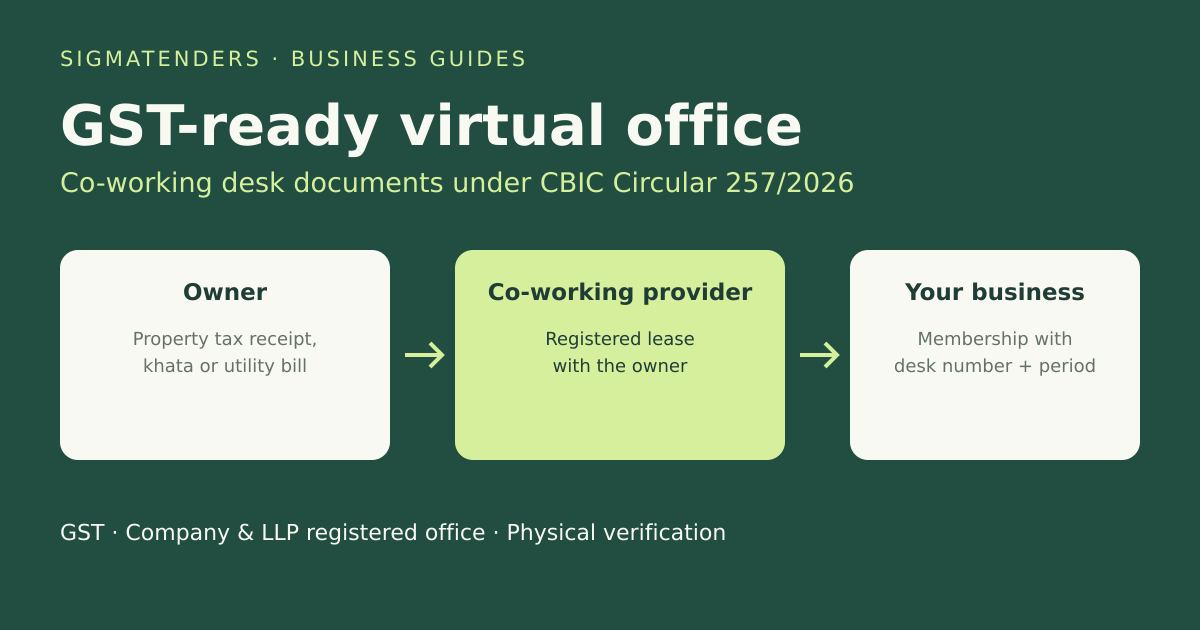
| Allotted co-working desk | Membership agreement with period and desk/suite/cabin number, plus provider ownership proof or its registered owner-provider lease | Para 3.8.5 and FAQ Q.26 |
For a simple desk-based practice, compare access, privacy, document availability, mail handling and inspection arrangements. A low monthly fee is less useful if you cannot obtain the underlying lease or reach anyone at the premises.
If the landlord or society refuses an NOC#
First establish what is missing. A separate landlord NOC is not listed as an additional universal requirement under the rental-document route. Para 3.8.3(a) distinguishes registered agreements, agreements not requiring registration and tenant-named utility evidence. Review your actual rent agreement for GST against that paragraph. Circular 257, para 3.8.3
If family property is available with the owner’s agreement, use the plain-paper consent format in Annexure VI, recording the parties, relationship, premises and allocated portion where applicable. For this consent route, all co-owners must consent. By contrast, FAQ Q.37 concerns an applicant who is themselves a co-owner: it says another co-owner’s NOC is unnecessary, with joint-ownership evidence where required. These are different situations. Para 3.8.4 and FAQ Q.37 · GST NOC generator
Where no rent agreement exists, para 3.8.3(b) provides an Annexure V undertaking route with possession evidence, such as the latest electricity or water bill in the tenant’s name. This requires the stated facts to be true; it is not a substitute for permission that was refused. Circular 257, para 3.8.3(b) and Annexure V
For a society objection, ask an adviser to review the tenancy terms, society documents and applicable property-use rules before proceeding. Do not assume the GST proof list resolves that dispute. If permission remains contested, consider another premises or a documented co-working membership. The circular directs officers against subjectively treating residential premises as unfit for business; this is GST application guidance. Circular 257, para 6
What a virtual office for freelancers should include#
The circular does not mention “virtual office”. Its express co-working route requires an allotted desk, cabin or suite and the proper premises-document chain. An address-only plan without these is weaker against the specified requirements. Check our virtual office for GST registration guide before choosing a provider. Circular 257, para 3.8.5
For leased co-working premises, ask for the registered agreement between the property owner and provider, alongside your membership. A provider’s assurance is insufficient if it cannot supply that document. Para 3.8.5 and FAQ Q.26
Refund claimants: prepare for closer verification#
A refund claim involves examining eligibility and evidence as well as the business’s registration. Service-export refund documentation includes invoice details and relevant BRC/FIRC evidence. Keep payment records reconciled to invoices rather than relying on a bank balance screenshot. Circular 125, para 48 and Annexure A
Physical verification can arise under the registration rules; Circular 257, para 5.6, requires the officer’s REG-30 report and GPS-enabled site photographs. Separately, Circular 131/1/2020-GST explains risk-based verification following fraudulent goods-export IGST refunds. That goods procedure should not be presented as an automatic inspection requirement for every freelancer claiming a service-export ITC refund. Registration verification · Goods-export verification SOP
The practical implication is to make your business and claim easy to substantiate. The following is a recommended preparation file, not an extra mandatory REG-01 upload list.
Keep an export and premises file ready
- Signed contracts, deliverables and correspondence showing your role and recipient.
- Export invoices matched to bank receipts, remittance references and BRC/FIRC evidence.
- LUT acknowledgement, filed returns and the reconciliation supporting any refund.
- Purchase invoices and records supporting the input tax credit claimed.
- The current home-office consent, rent agreement or desk membership and underlying premises proof.
- A clear desk location, access arrangements and a contact who can help locate the business.
The legal document bases are Circular 125, Annexure A and Circular 257, paras 3.7–3.8 and 5.6. Use the broader GST document checklist to organise your application.
FAQ Q.35 says applicant/landlord photographs are not required or accepted as premises proof; that does not remove officer-taken verification photographs. Para 5.4.1 prohibits irrelevant presumptive queries. Para 5.7 provides deemed approval where no action occurs within the applicable rule 9 period, not a blanket promise of instant approval. Circular 257
SigmaTenders offers a GST-ready virtual desk through verified partner co-working spaces, with an allotted desk number, document-pack support, GST/MCA application support with a CA, physical-verification preparation and mail handling. Price on request. The service is available through partner spaces; we confirm availability in your city within 48 hours. Explore our virtual office service, or ask us about a GST-ready address for your freelance practice.
Frequently asked questions#
Do freelancers need GST registration below ₹20 lakh?
Ordinary service suppliers can remain below the applicable threshold, including under the interstate-services exemption, unless another compulsory-registration ground applies. The service threshold is ₹10 lakh in the four specified states. CBIC thresholds · Interstate exemption
Is every payment from a foreign client zero-rated?
No. All five export conditions must be satisfied, including an overseas place of supply and permitted receipt of payment. IGST section 2(6), official reproduction
Does LUT registration online replace GST registration?
No. RFD-11 is filed through a registered taxpayer’s account for the relevant financial year. It is distinct from the GST registration application. GST Portal LUT manual
Can I use my parents' home for GST registration?
For the consent route, obtain the owner’s signed Annexure VI letter and listed property evidence; do not declare it self-owned. Co-owned family property requires all owners’ consent under this route. Circular 257, para 3.8.4
Can a co-working membership support GST registration for consultants?
Yes, the circular expressly specifies this route, with an allocated desk/suite/cabin, membership period and provider ownership proof or registered owner-provider lease. Approval still depends on the application and applicable verification. Circular 257, para 3.8.5 and FAQ Q.26
Does an LUT automatically release a GST refund?
No. Filing an LUT and claiming a refund are separate processes. Refund eligibility and supporting records must be assessed; relevant claims are filed through RFD-01. Circular 125, paras 3–4 and Annexure A